I. The "Heat" and "Stress" Challenges Behind the Energy Storage Boom
In 2025, China's new-type energy storage installed capacity exceeded 80 million kilowatts. As the core hub connecting battery systems to the power grid, the reliability of Power Conversion Systems (PCS) directly determines the operational efficiency of entire energy storage stations. Inside the PCS, IGBT (Insulated Gate Bipolar Transistor) modules are the most critical heat-generating components—a single module under full load can dissipate several kilowatts of power loss, with local heat flux exceeding 100W/cm², far beyond the tolerance limit of conventional thermal designs.
At the same time, the packaging structure of IGBT modules faces severe mechanical challenges. During power cycling, thermal expansion mismatch between the chip and substrate (silicon chip approx. 2.6ppm/℃, DBC ceramic substrate approx. 7ppm/℃, copper baseplate approx. 17ppm/℃) generates repeated shear stress at the solder joint interface. After long-term operation, this leads to solder fatigue cracking, sharp increases in thermal resistance, and eventual module failure.
Thermal failure and packaging cracking are the two core pain points shortening IGBT module lifespan.

II. High-Thermal-Conductivity Grease: Eliminating the "Last Centimeter" Thermal Barrier
Even after precision machining, microscopic surface irregularities remain between the IGBT module and heatsink. With air thermal conductivity at only approximately 0.026W/m·K, these gaps create severe thermal resistance bottlenecks. As a thermal interface material (TIM), high-thermal-conductivity grease fills these microscopic voids, reducing interface thermal resistance from 0.5–2.0K·cm²/W for bare contact to 0.05–0.2K·cm²/W—a reduction of over 90%.
Energy storage applications impose far stricter requirements on thermal grease than standard industrial grades: thermal conductivity must be ≥5.0W/m·K, thermal resistance ≤0.1K·cm²/W, operating temperature range -55~200℃, and after more than 1,000 thermal cycles it must not crack, dry out, or pump out, with a service life of 10 years or more.
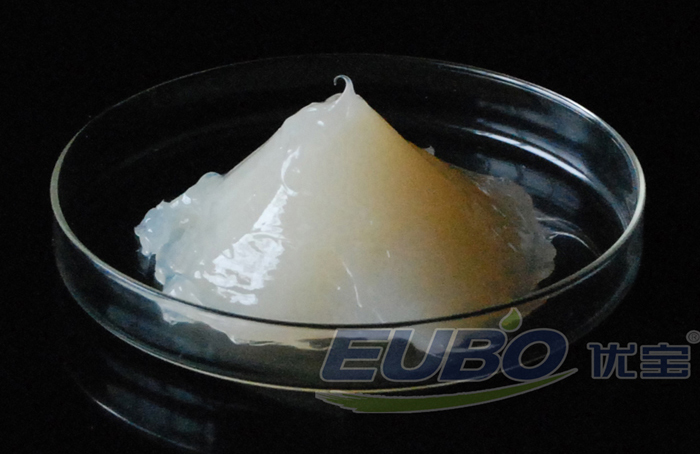
Shenzhen EUBO New Materials Co., Ltd. has developed D605 High-Thermal-Conductivity Grease specifically for energy storage and power semiconductor applications. Utilizing a nano-alumina and boron nitride composite filler system with special surface treatment, it achieves multiple critical performance breakthroughs:
-
Thermal conductivity of 6.0W/m·K, with thermal resistance as low as 0.08K·cm²/W (@50μm thickness), reducing IGBT junction temperature by 15–25℃
-
Anti-pump-out formulation: After 1,000 thermal cycles from -55℃ to 150℃, mass loss is less than 3%, with no cracking or powdering
-
Excellent electrical insulation: Volume resistivity greater than 1×10¹⁵Ω·cm, meeting high-voltage insulation requirements for energy storage systems
-
Wide-temperature stability: Continuous operation from -55℃ to 200℃, adapting to extreme temperature differentials in outdoor energy storage
-
Low-stress application: Excellent thixotropy, enabling uniform thin layers of 50–100μm via screen printing or dispensing
Measured Data: In a prototype 320kW PCS from a leading energy storage company, replacing the original imported thermal pad with D605 reduced the maximum IGBT junction temperature from 142℃ to 118℃, and power cycling lifetime (ΔTj=80K) increased from 30,000 to over 80,000 cycles.
III. Underfill Adhesive: A "Flexible Armor" for Chip Solder Joints
IGBT modules typically employ a three-layer structure of chip-solder-DBC substrate. During power cycling, thermal expansion mismatch between the chip and substrate generates cyclic shear stress at the solder joints. For a typical 1200V/600A IGBT module with a chip size of approximately 12mm×12mm and solder layer thickness of approximately 100μm, solder joint strain can reach 1–2% under ΔTj=80K power cycling, with crack initiation occurring after just thousands of cycles.
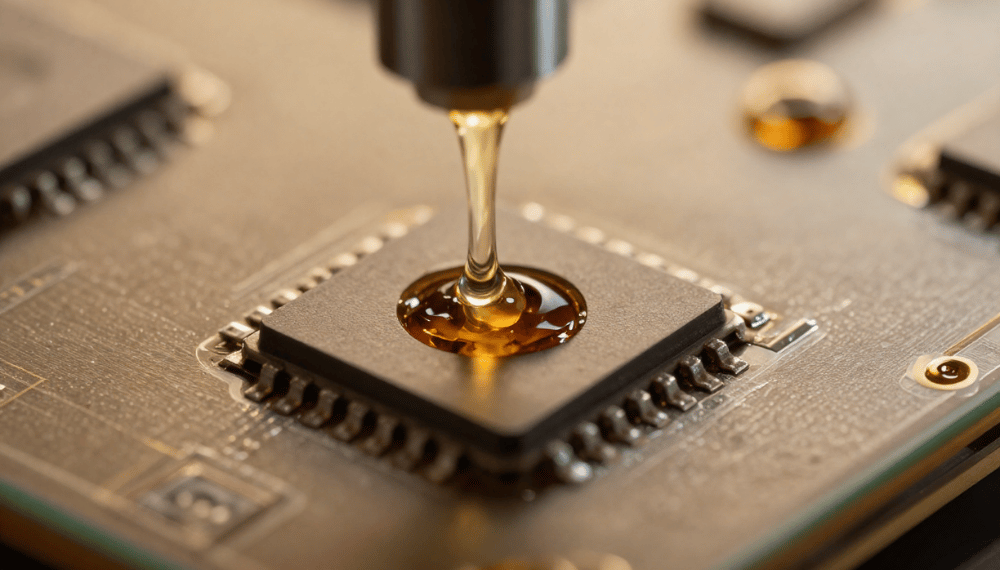
Underfill adhesive is a low-modulus, high-toughness epoxy-based adhesive that capillary-flows into the gap between the chip and substrate, curing to form an elastic buffer layer. Its core mechanisms include: redistributing concentrated stress from solder joints across the entire chip underside, reducing peak solder stress by approximately 50–70%; when microcracks appear in solder joints, the toughness of the fill adhesive arrests crack propagation; and by adjusting the coefficient of thermal expansion (CTE) through filler content, bringing it between that of the chip (2.6ppm/℃) and substrate (7–17ppm/℃) to minimize interfacial shear strain.
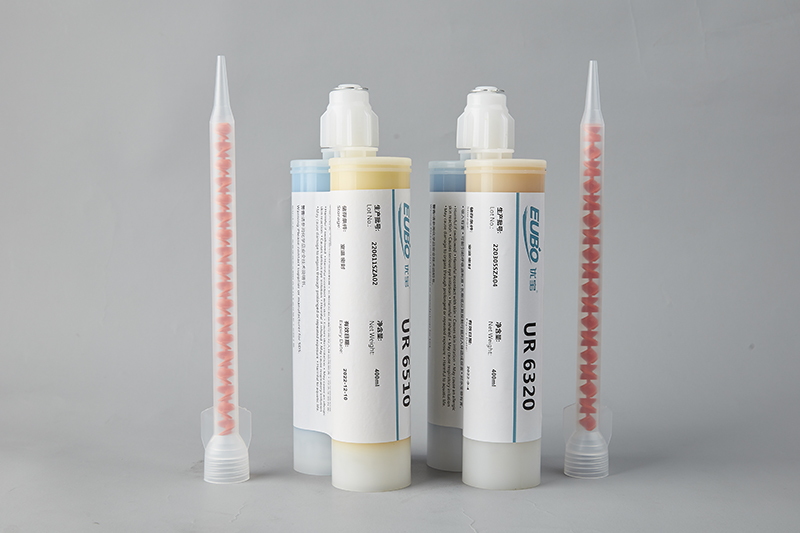
EUBO New Materials has developed Underfill Adhesive Series Products specifically optimized for power semiconductor packaging:
The UF-500 grade features a viscosity of 5,000mPa·s, CTE of 30ppm/℃, glass transition temperature (Tg) of 135℃, and elastic modulus of 10GPa, suitable for standard IGBT chips with 50–100μm gaps. Under 80℃ preheating conditions, it can complete underfilling of a 12mm×12mm chip within 30 seconds. Through nano-silica filler surface modification, it achieves a synergistic optimization of low CTE and high Tg. After 1,000 hours at 85℃/85%RH, shear strength retention exceeds 90%. It features a halogen-free formulation compliant with IEC 61249-2-21 and meets RoHS 2.0 requirements.
Reliability Verification: In an automotive-grade IGBT module, using UF-500 underfill increased power cycling lifetime (ΔTj=100K) from the original design of 20,000 to 50,000 cycles, meeting AEC-Q101 Grade 0 standards.
IV. Synergistic Solution: Integrated Design for Heat Dissipation and Protection
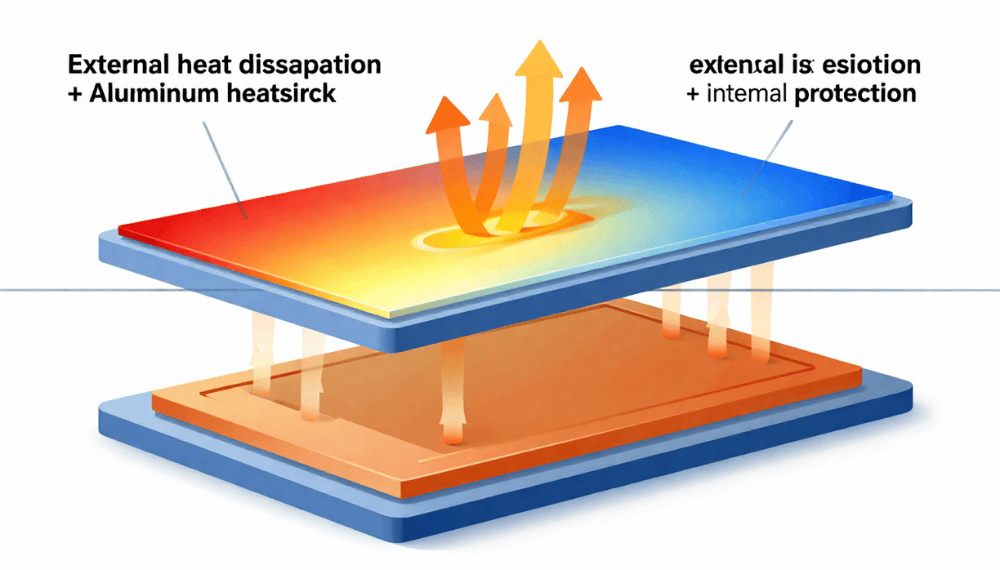
In practical applications, high-thermal-conductivity grease and underfill adhesive work together as a synergistic "external heat dissipation, internal protection" system. The thermal grease sits between the IGBT module baseplate and heatsink, responsible for rapid heat extraction; the underfill adhesive fills the gap between the chip and DBC substrate, responsible for buffering thermal stress and suppressing solder joint cracking.
Three points require attention in synergistic design: The thermal grease coating thickness (50–100μm) must be coordinated with module flatness and pressure uniformity to avoid localized thin spots causing uneven thermal resistance; the underfill adhesive cure temperature profile (typically 150℃/30 minutes) must be compatible with the overall module packaging process to avoid thermally aging the thermal grease; and combined thermal cycling testing (-55℃ to 150℃, 1,000 cycles) must be performed to monitor interface thermal resistance changes and solder joint shear strength degradation.
V. EUBO's Technical Support System
Shenzhen EUBO New Materials Co., Ltd. has specialized in specialty lubrication and adhesive materials for over twenty years, providing full-chain technical support for the energy storage and power semiconductor industries. The company operates a CNAS-accredited testing center equipped with thermal conductivity analyzers, DMA dynamic mechanical analyzers, and TMA thermomechanical analyzers, offering customers customized material characterization and failure analysis. Through its joint laboratory with Shenzhen Tsinghua University Research Institute, it continuously develops core technologies in nano-filler surface modification and low-stress epoxy formulations. Its product line extends from thermal grease and thermal gel to underfill adhesive and module edge-sealing adhesive, meeting the full material requirements for IGBT packaging. Products have been mass-deployed in energy storage PCS, new energy vehicle electric drives, photovoltaic inverters, and industrial frequency converters, with annual shipments exceeding 50 million units.
VI. Conclusion
The large-scale development of the energy storage industry has placed unprecedented thermal management and reliability demands on power semiconductor devices such as IGBTs. The synergistic application of high-thermal-conductivity grease and underfill adhesive has become a critical technical path for improving module power density and cycling lifetime. Shenzhen EUBO New Materials Co., Ltd. will continue focusing on the new energy and semiconductor sectors, driving the energy transition through materials innovation, and providing customers with integrated "heat dissipation + protection" solutions.
About Shenzhen EUBO New Materials Co., Ltd.
Shenzhen EUBO New Materials Technology Co., Ltd. (EUBO), founded in 2000, is a national high-tech enterprise specializing in the R&D, production, sales, and service of specialty lubricating greases and adhesives. The company operates a CNAS-accredited laboratory and a joint laboratory with Shenzhen Tsinghua University Research Institute. Its products are widely used in automotive, electronics, new energy, robotics, aerospace, and other fields, and have passed international certifications including IATF 16949, ISO 9001, ISO 14001, and NSF.